DESI EDR VAC (Samuel Helps)
1.6M
- 1,666,815 DESI galaxy spectra fitted with MaStar stellar population models
- Derived: Stellar and Remnant masses, metallicities, Luminosity-weighted and Mass-weighted Ages
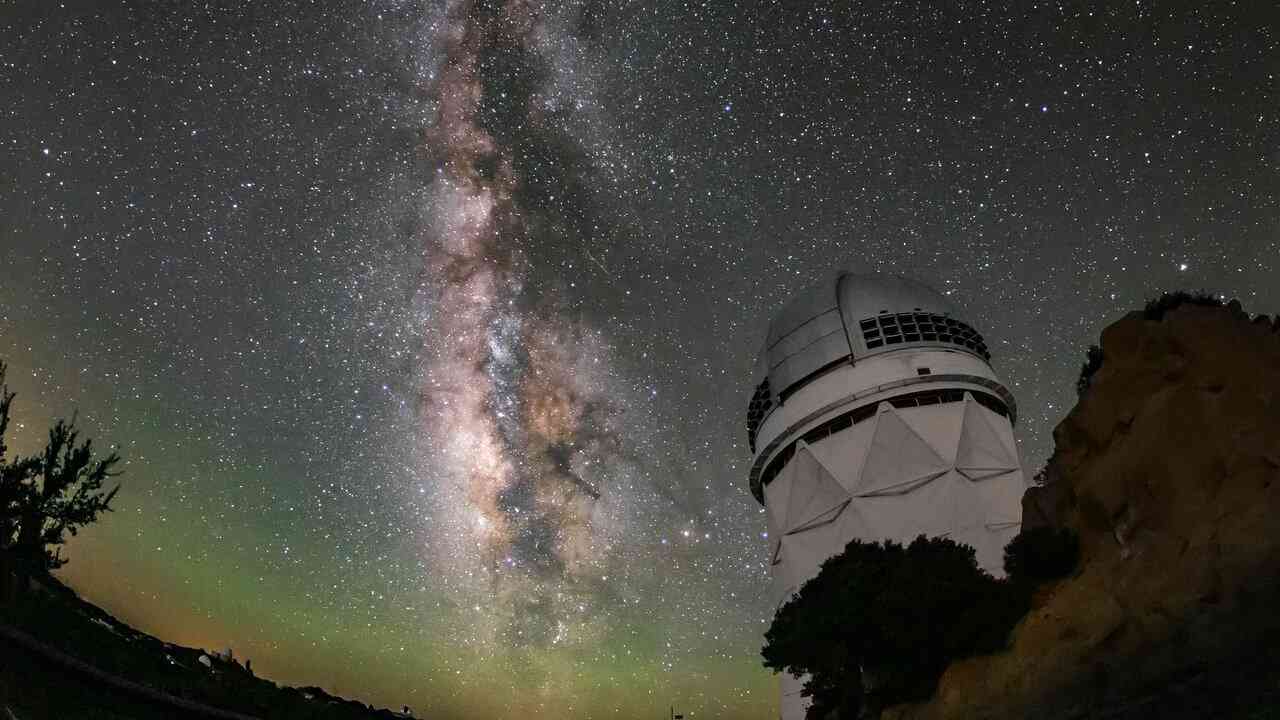
The Dark Energy Spectroscopic Instrument (DESI) marks the next-generation of wide-field spectroscopic survey in observational cosmology and galaxy evolution. Installed on the 4-metre Mayall Telescope at Kitt Peak National Observatory (Arizona), equipped with 5,000 robotic fibers and ten spectrographs covering 3600-9800 Å at R≈2000-5000, DESI will map tens of millions of galaxies, quasars and stars across ~14,000 deg² of sky.
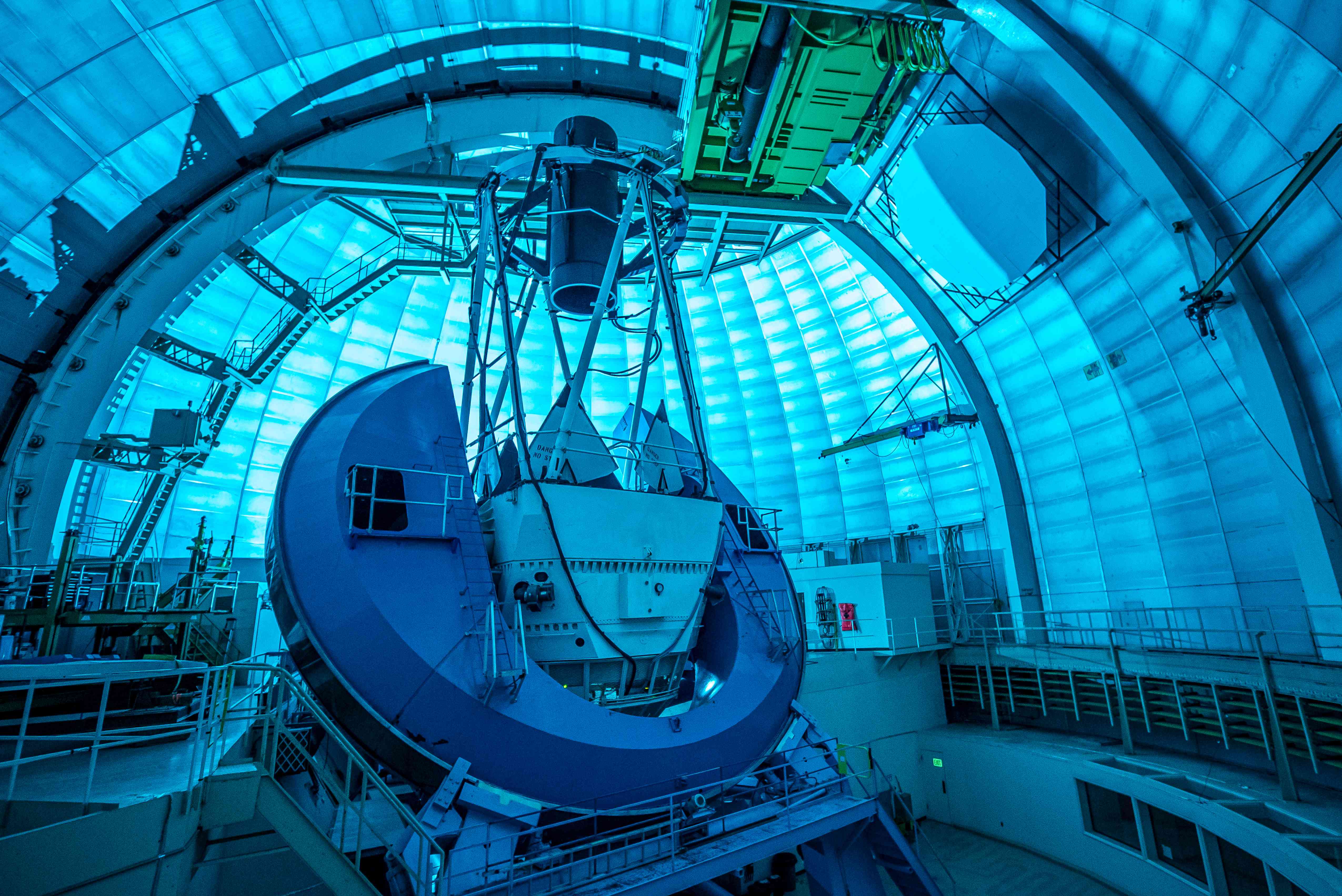

Designed for precision cosmology, DESI will help unlock the mysteries of cosmic expansion and the role of dark energy in shaping the cosmos. Besides its primary goal to map the expansion history of the Universe via baryon acoustic oscillations and redshift-space distortions, DESI also provides the opportunity to perform stellar population studies with crucial insights into galaxy formation and evolution using its enormous spectroscopic dataset. DESI's target selection includes 7 million Milky Way stars, 14 million Bright Galaxy Survey (BGS) galaxies, 7.5 million Luminous Red Galaxies (LRGs), 15.5 million Emission Line Galaxies (ELGs) and 3 million quasars.
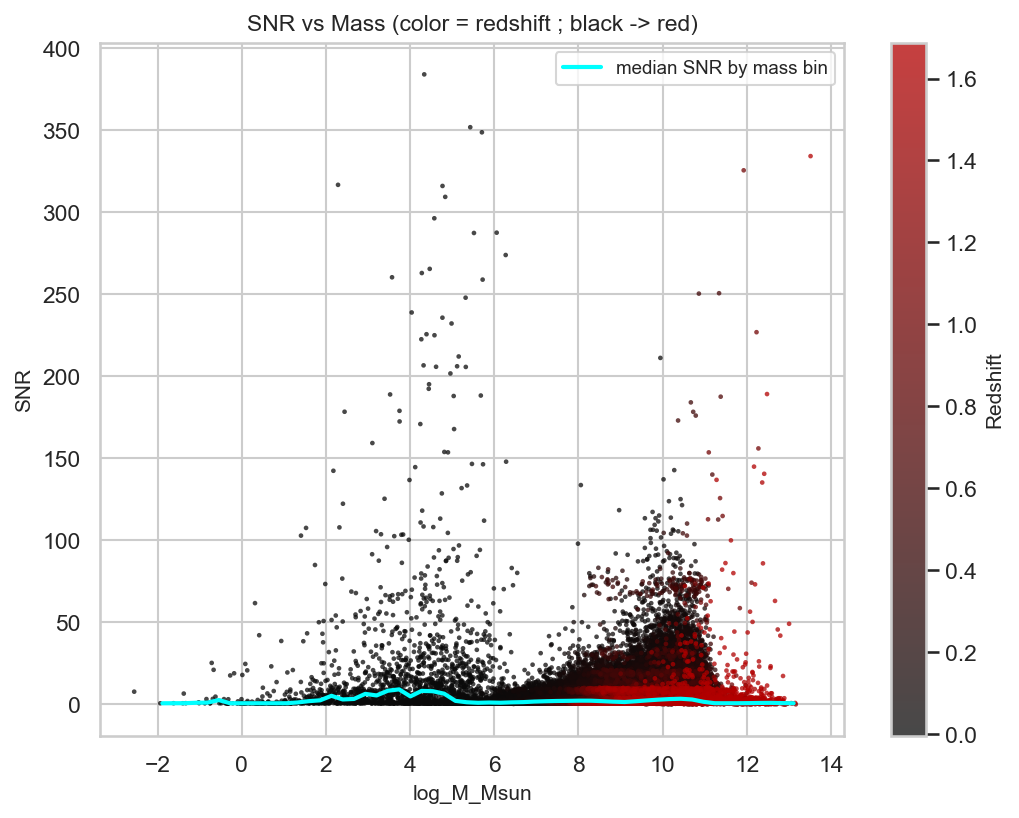
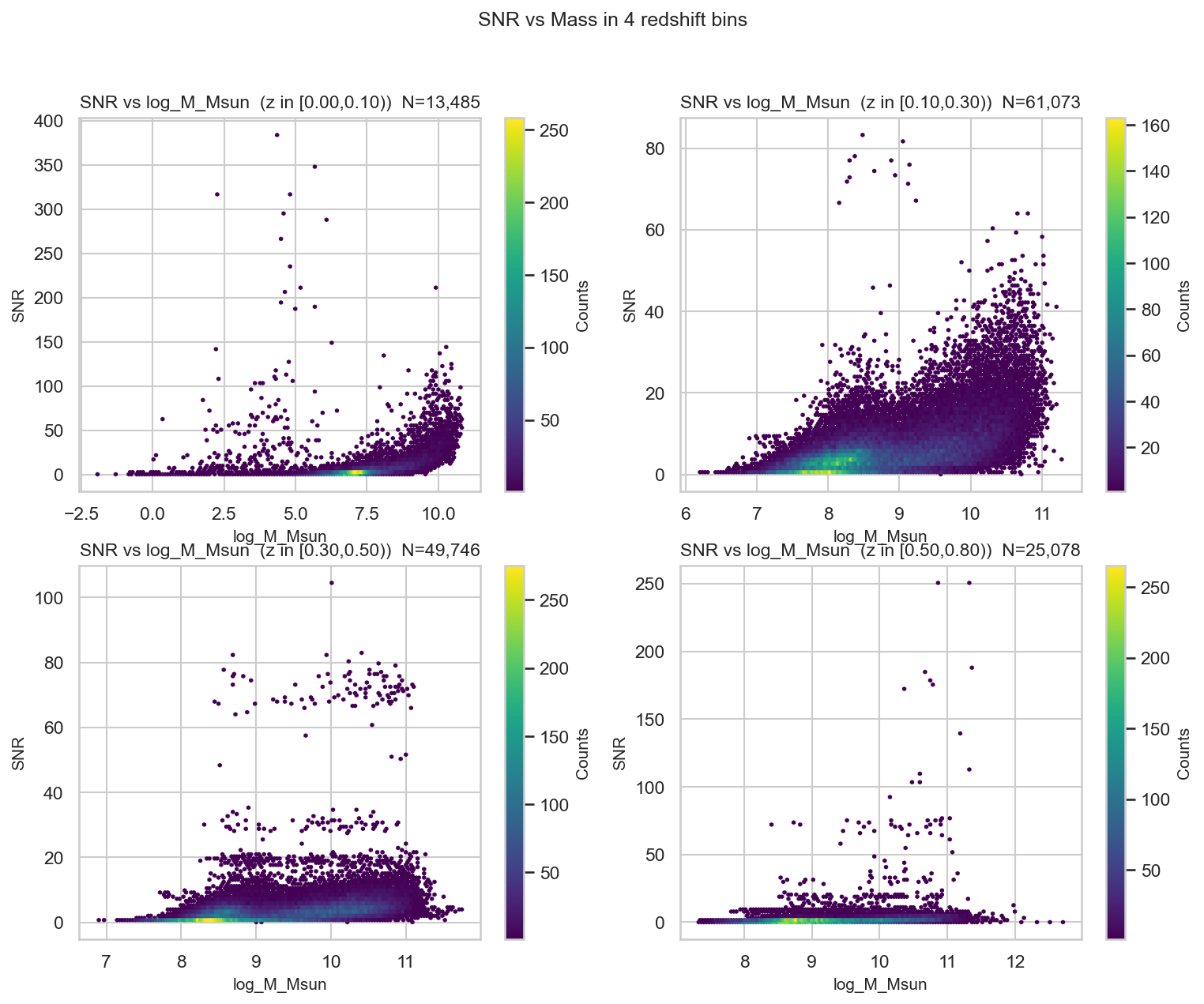
With DESI's superior instrumentation, broader wavelength range and higher resolution compared to SDSS, the survey will vastly surpass its predecessors in sample size, allowing for unprecedented statistical power in studying galaxy populations across cosmic time. The new robotic positioner replaces SDSS's fixed fibre plates, allowing 5000 simultaneous exposures and flexible tiling. Moreover, DESI's depth and observing strategy yield much higher S/N for much fainter targets and in practice, DESI routinely attains S/N > 0.5 per Å in 4000 sec exposures even for objects at z > 2.
These improvements prove crucial for galaxy analysis. Higher spectral resolution and S/N mean faint absorption features and continuum shapes are measured more precisely, enabling reliable stellar population fits out to much greater redshifts. DESI's wide sky coverage and breadth of targets, offers a rich and diverse galaxy sample for stellar population studies.
The Dark Energy Spectroscopic Instrument (DESI) Early Data Release (EDR) marks the first major milestone in one of the most ambitious spectroscopic surveys ever conducted. Between 2020 - 2021, DESI completed its Survey Validation (SV) phase and began full operations, collecting 1.77 million high-quality spectra across its five core target programs: Milky Way Survey (MWS), Bright Galaxy Survey (BGS), Luminous Red Galaxies (LRGs), Emission Line Galaxies (ELGs), and Quasars (QSOs).
The FIREFLY DESI-EDR VAC (by Samuel Helps) contains over 1.6 million DESI galaxy spectra from the, fit for the first time with MaStar and FIREFLY's full-spectral fitting. The VAC provides some of the first insights into FIREFLY's capabilites deriving the properties of galaxies from an entirely new and upgraded survey, providing a completly new sample for studies of stellar populations across a wide range of mass, redshift and galaxy type.
The following sky map shows the EDR tiling used to build the sample fit using FIREFLY. The footprint is patchy but broad, reflecting on the influence of Survey Validation and early survey fields on the EDR.
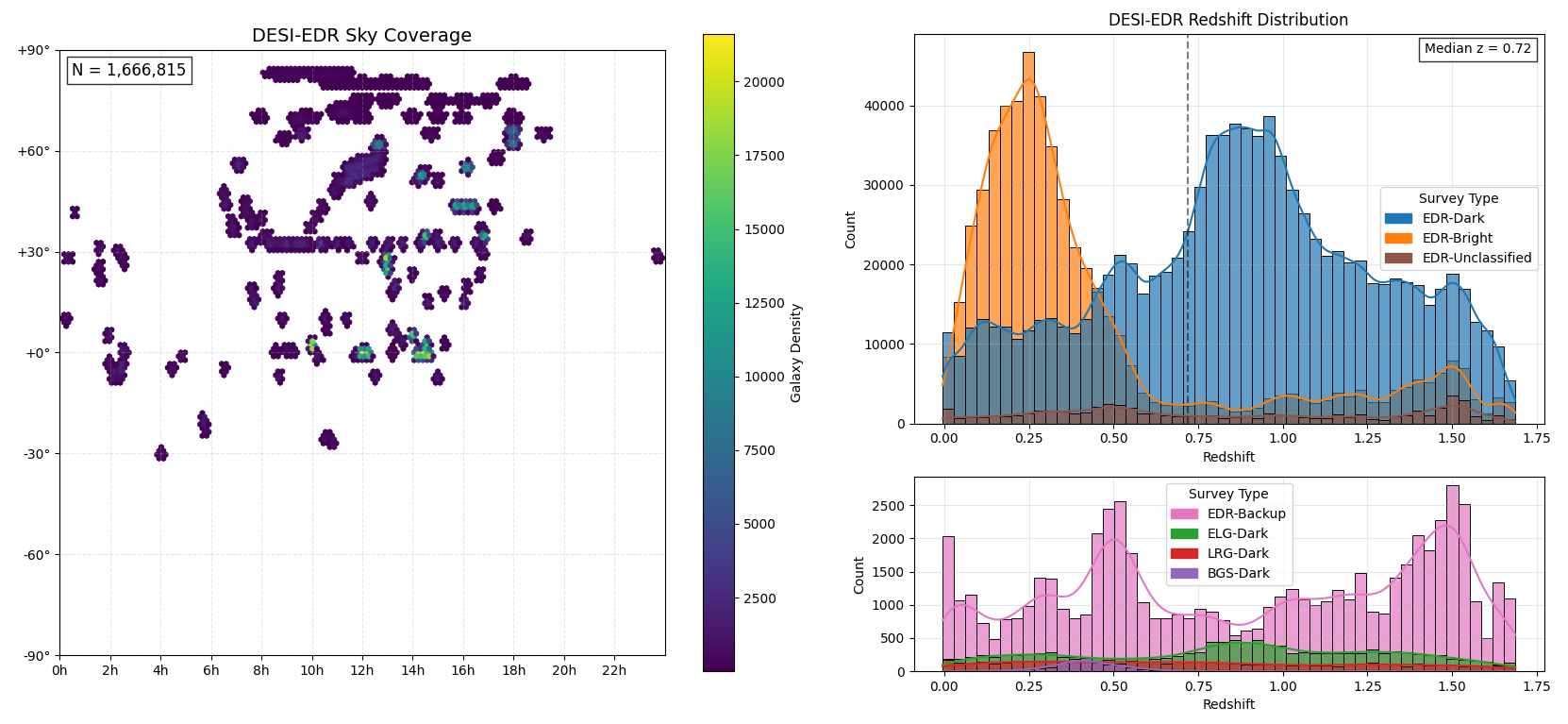
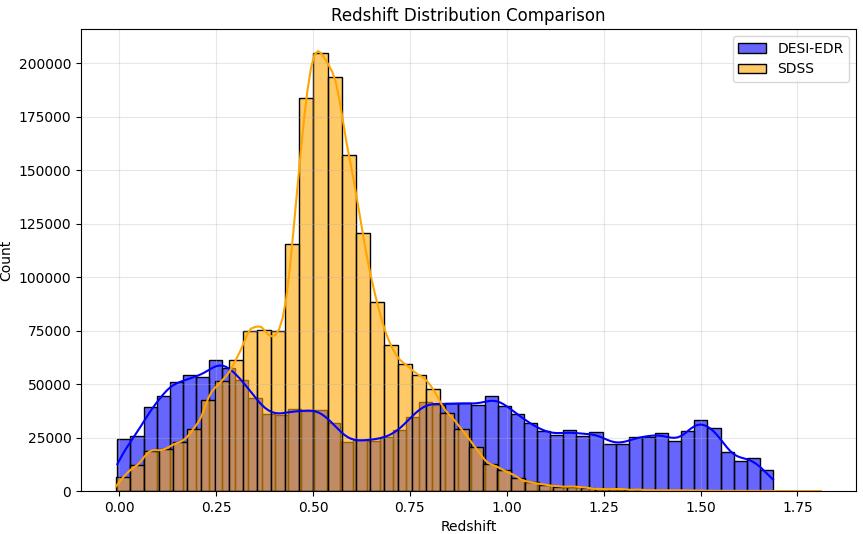
The galaxy catalog spans from the local universe out to z ≳ 1.5 with clear multi-modal structure driven by the DESI target classes (BGS, LRG, ELG, QSO). BGS targets tend to dominate the sample at low-to-intermediate redshift, while ELGs and LRGs fill the higher-z regime. This range of target galaxy type improves the statistical viability of studies that now have more ability to distinguish changes in galaxy characteristics between different galaxy populations.
.png)
.png)
.png)
.png)
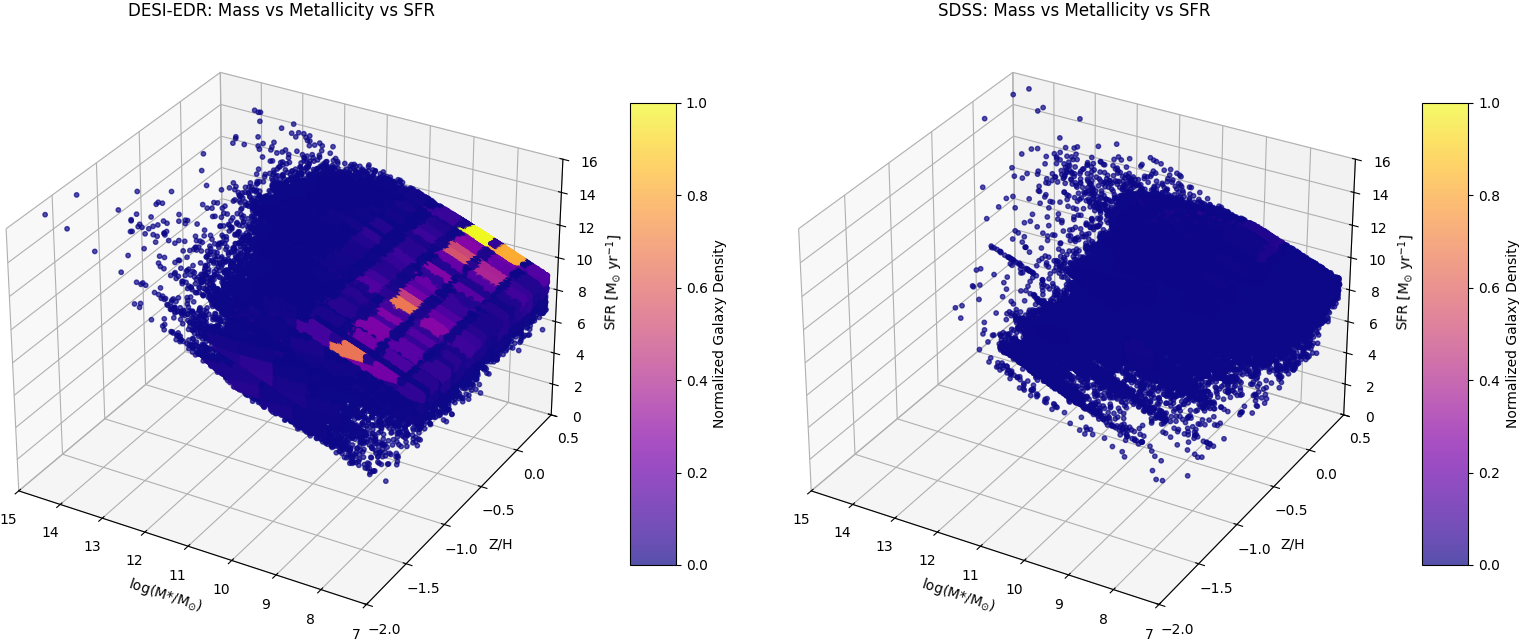
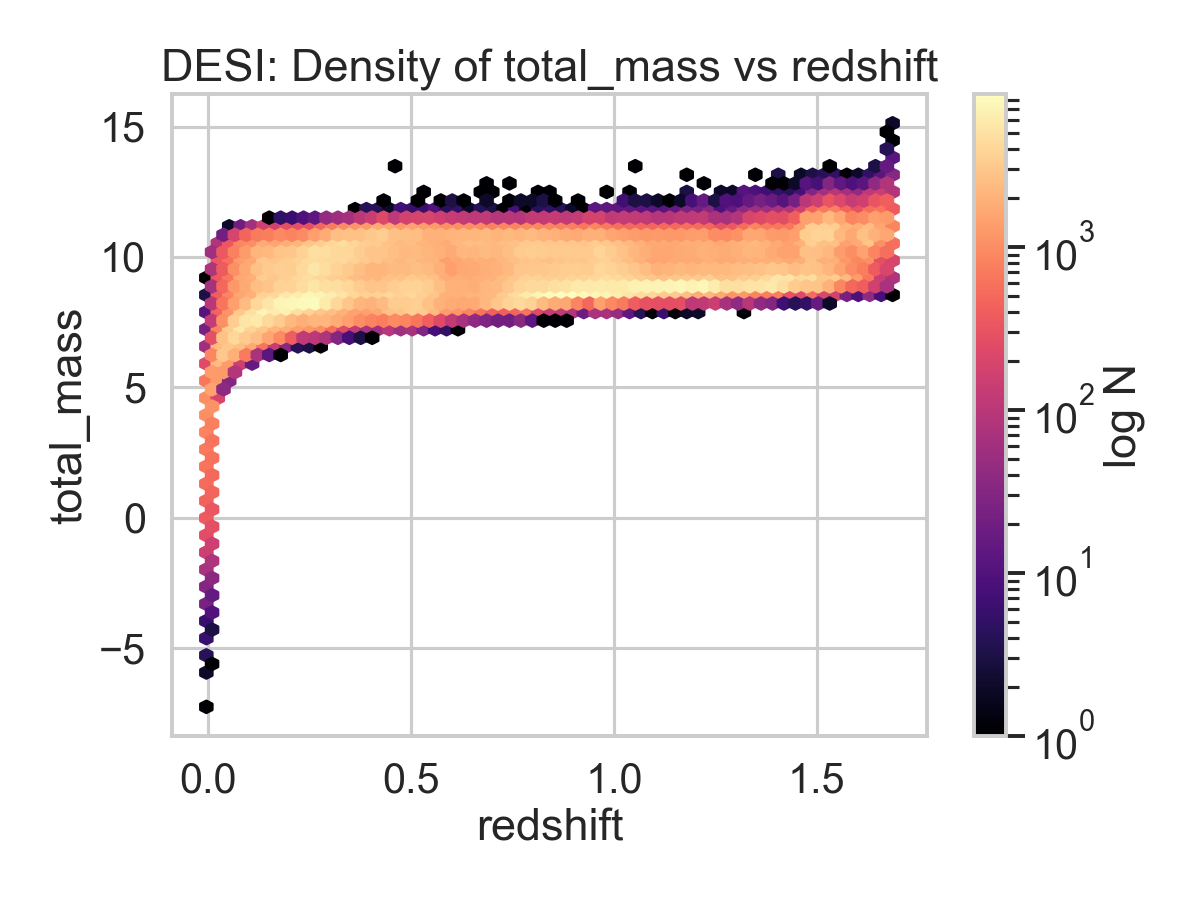
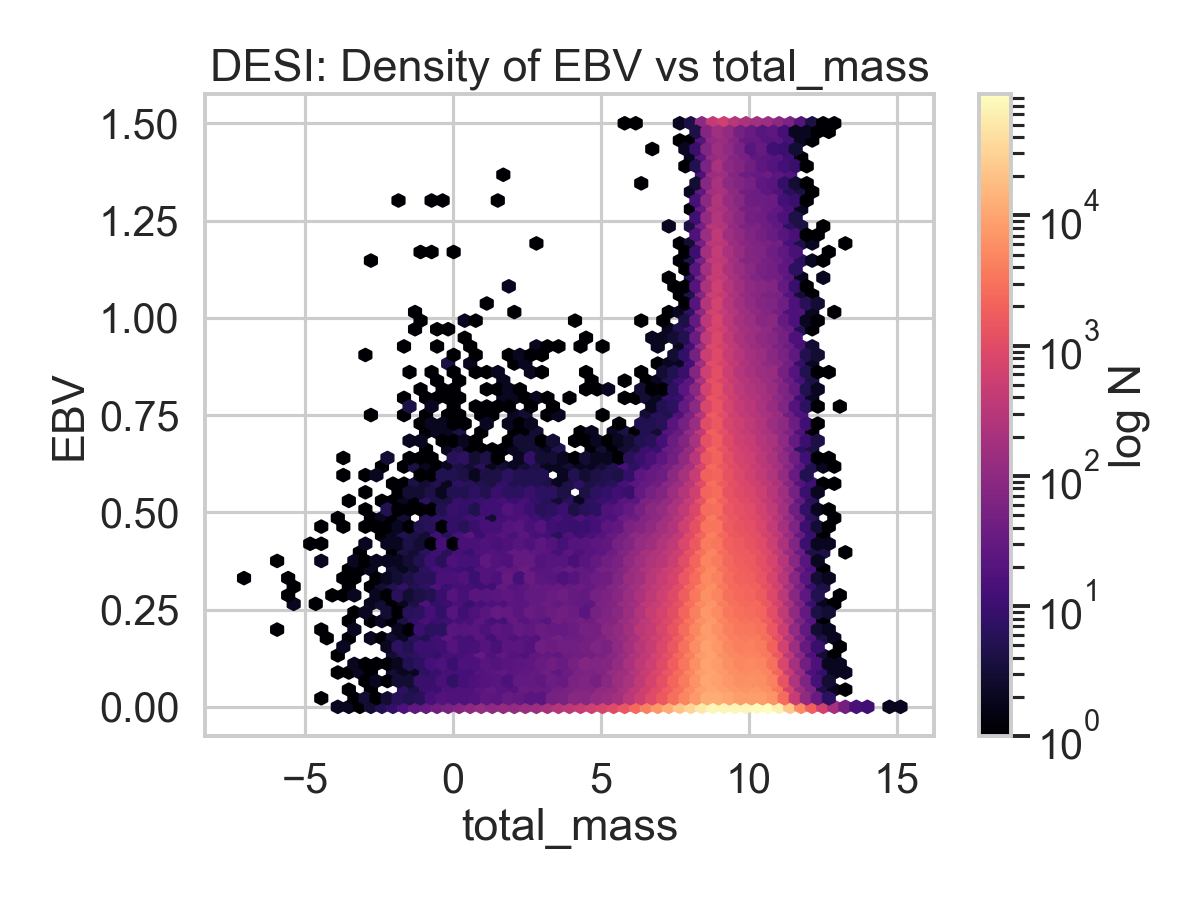
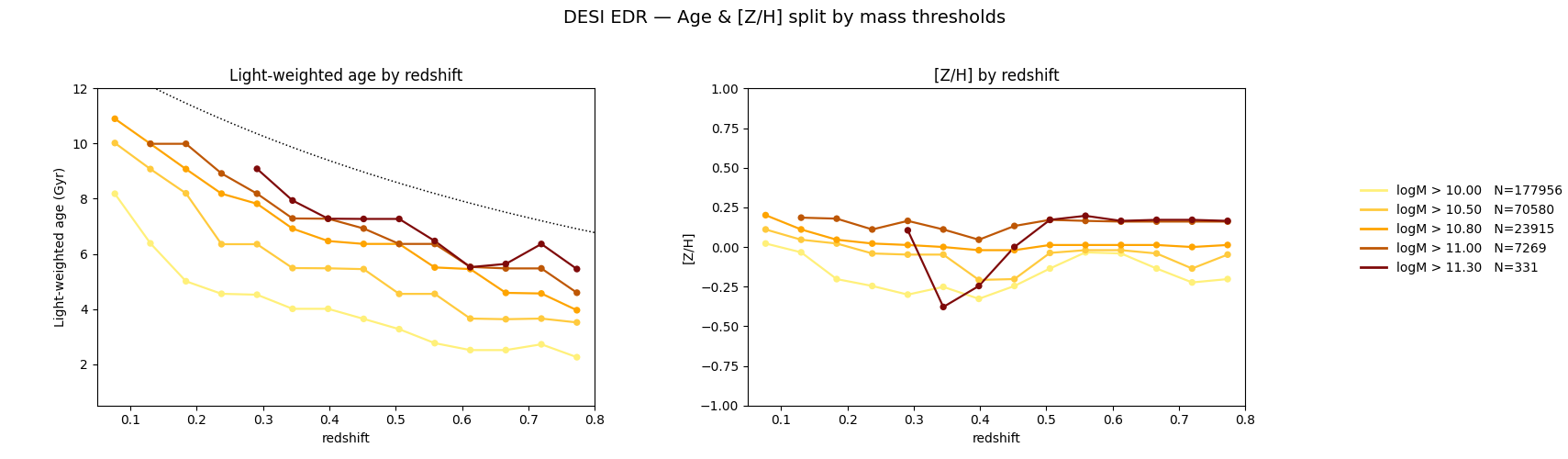
Age and metallicity trends remain tight across the survey where massive galaxies stay old and metal-rich while lower-mass systems are younger with flatter [Z/H] evolution. FIREFLY also finds stellar populations ages to be well constrained by the cosmological age barrier (dotted line - Planck15 Cosmology).
Stability check
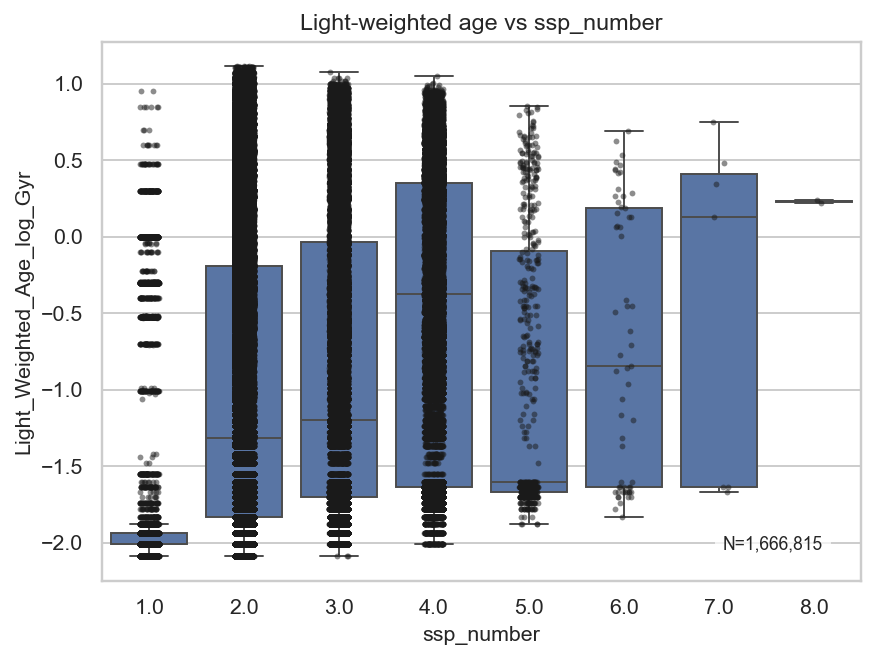
When analysing the number of model combinations FIREFLY uses across the sample, the code performs well on the new DESI spectra, consistently averging a around three SSP combinations in its parameter derivation, reducing age gridding and potential bias on model library complexity.
The DESI EDR FIREFLY VAC provides a unique stellar population analysis using full spectral fitting with MaStar models. Comparing with alternative methods like FastSpecFit, which employs a different fitting approach and models, can enable validation of derived properties and reveal systematic differences in stellar age and mass estimates between methodologies.
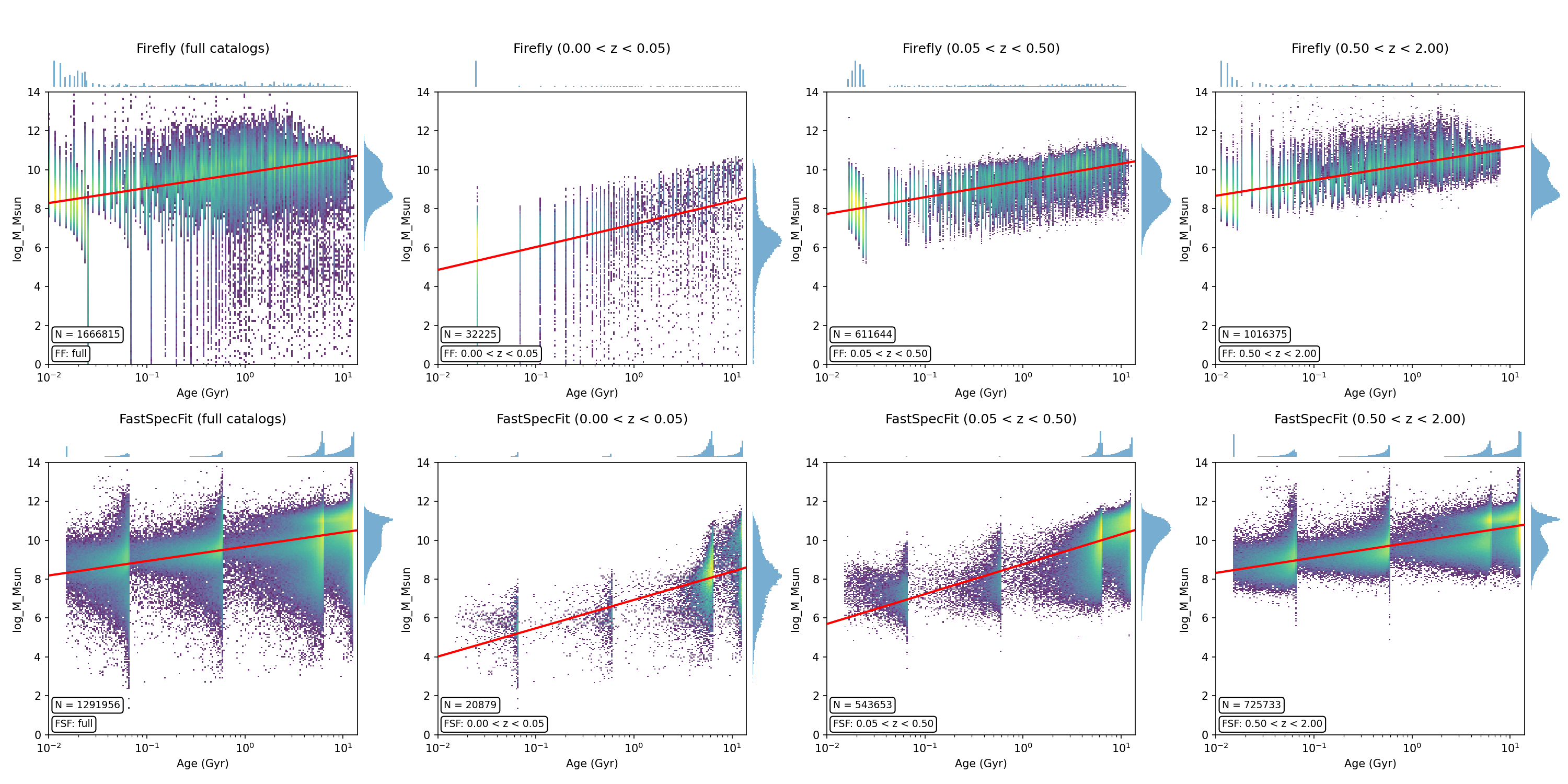
FIREFLY's consistent performance across major spectroscopic surveys demonstrates the adaptability of the algorithm. Comparing the DESI EDR sample with previous FIREFLY SDSS VACs, using the same models and IMF, reveals how stellar population properties can evolve across different survey depths, wavelength coverage, spectroscopic fiber widths and target selection strategies. The DESI sample extends to higher redshifts, targeting a much more homegenous sample and consquently providing different constraints on galaxy evolution.